
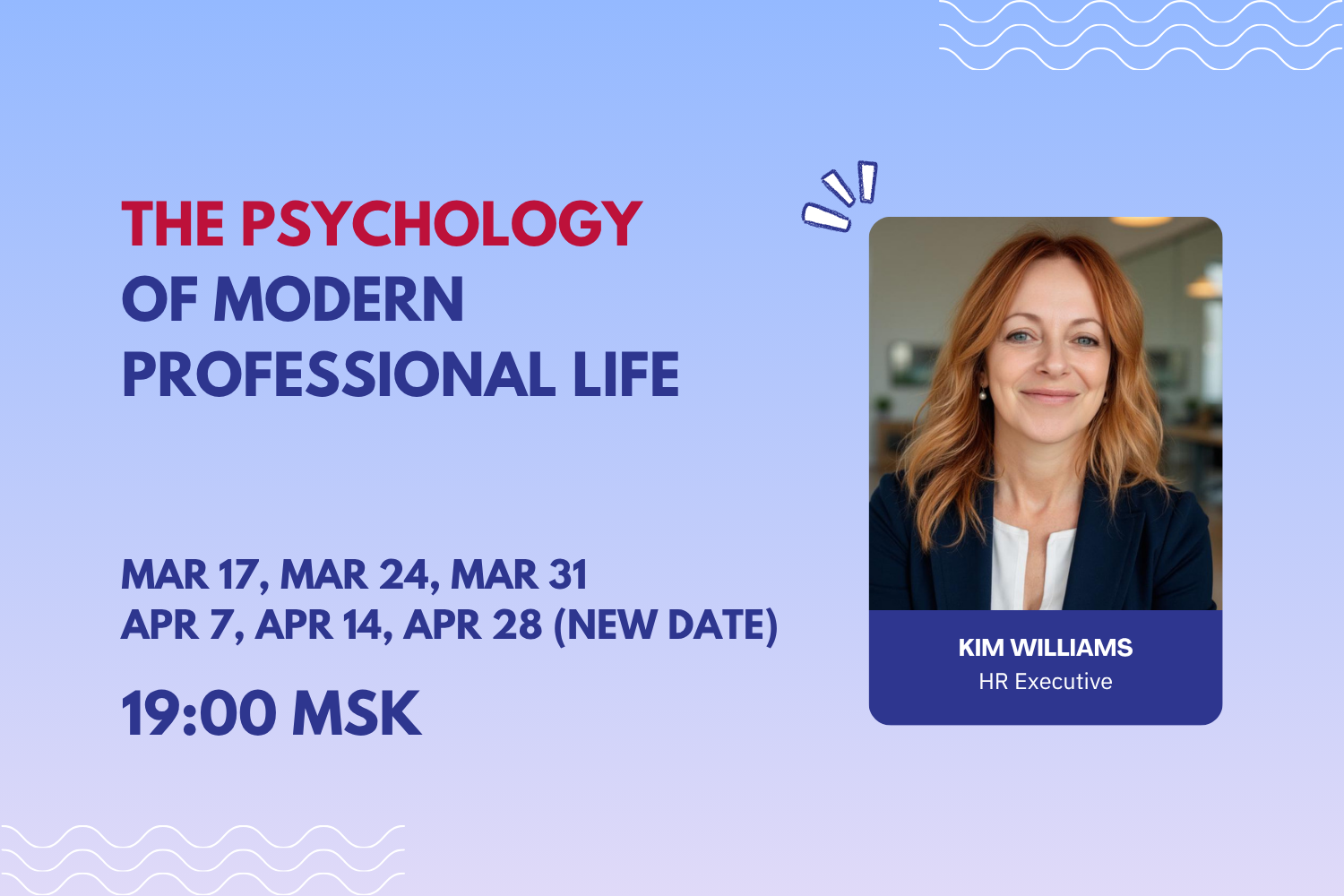
Course Introduction
The Psychology of Modern Professional Life Webinar Series is a six-session course designed to help internationally mobile professionals navigate career transitions, rebuild confidence, and develop sustainable professional paths in a global environment.
The series explores how careers evolve across life stages, addresses challenges such as impostor syndrome, burnout, and toxic workplace dynamics, and offers practical frameworks for maintaining work–life balance while living and working across cultures. Participants will learn how to recognize and leverage their unique strengths as globally mobile professionals and develop strategies for building long-term career capital in an international economy.
Through expert insights, guided reflections, and practical tools, the course helps participants reframe professional setbacks, strengthen their professional identity, and create actionable plans for future career growth.
About the Speaker
Kim Williams is a seasoned HR executive and nationally recognized advocate for workplace justice. With over two decades of leadership in HR, she brings an insider’s perspective to the silent epidemic of workplace abuse. Kim is an advisory member of End Workplace Abuse and has testified before legislative bodies including the DC Council, Massachusetts Joint Labor Committee, and Rhode Island Senate to advance the anti-bullying legislation for workers. A sought-after speaker and trainer, she has delivered keynotes, podcasts, and workshops for organizations ranging from the U.S. Department of State to EW Scripps. Kim’s talks combine compelling storytelling with practical strategies.
Course Schedule
Each session takes place at 19:00 MSK.
March 17. Session 1. Career Mindsets Across Life Stages
March 24. Session 2. Impostor Syndrome and Confidence Building
March 31. Session 3. Burnout: Prevention, Recovery, and Sustainability
April 7. Session 4. Work–Life Balance for Global Professionals
April 14. Session 5. Toxic Workplaces: Recognition and Navigation
NEW DATE. April 28. Session 6. Building Career Capital in a Global Economy
Session 1. Career Mindsets Across Life Stages
Career life stage characteristics: Explorer, Builder, Contributor, and Restart
Growth mindset: talent as developed, not fixed
Narrative identity: the story we tell about our careers
Horizon shift: redefining what “progress” looks like post-relocation
Asset inventory: identifying transferable strengths across borders and cultures
Fixed vs. growth mindset applied to career transitions
Distinguishing externally-imposed narratives from internally-defined ones
Session 2. Impostor Syndrome and Confidence Building
The five impostor types: Perfectionist, Expert, Soloist, Natural Genius, Superhuman
How impostor syndrome differs from actual structural disadvantage
Language anxiety and credential gaps as compounding factors for diaspora professionals
Evidence file: a documented record of accomplishments and positive feedback
Reattribution: crediting skill, not luck, for professional successes
Desensitization through small, regular acts of professional visibility
Embodied confidence: posture, pacing, and voice as somatic tools
Session 3. Burnout: Prevention, Recovery, and Sustainability
The burnout arc: Pre-Burnout, Active Burnout, Crisis, and Recovery — self-location tool
Three burnout dimensions: exhaustion, cynicism, and reduced professional efficacy
Job Demands–Resources model applied to individual situations
Diaspora-specific burnout accelerators: dual performance pressure, invisible grief, hypervigilance
Micro-recovery: deliberate 10–15 minute restoration practices during the workday
Boundary design: clear start/end signals and protected non-work time
Role re-crafting: identifying which tasks are most depleting and negotiating adjustments
Session 4. Work–Life Balance for Global Professionals
Beyond the balance metaphor: integration vs. separation, seasons of imbalance, energy management
Values clarification as the foundation for allocation decisions
Temporal boundaries: fixed work hours and protected non-work time blocks
Spatial and digital boundaries: workspace design and notification management
Transnational family care and the 24-hour workday illusion
Cultural work norms across host countries: navigating different expectations as an outsider
The integration tax: cognitive and emotional overhead of cross-cultural daily life
Session 5. Toxic Workplaces: Recognition and Navigation
The toxicity spectrum: Difficult (manageable) → Dysfunctional → Toxic — with clear indicators for each
Common patterns: gaslighting, retaliation culture, structural exclusion, performative inclusion
Visa and work permit dependency as a factor limiting self-advocacy
The cultural interpretive gap: discrimination vs. cultural norm in the host country
Documentation: date, specific behavior, witnesses, your response, emotional impact
Internal escalation: understanding HR processes and their limits in your specific country
Strategic exit planning: building options before you need them urgently
Session 6. Building Career Capital in a Global Economy
Four career capital dimensions: Skills, Social, Reputation, and Knowledge capital
Multilingualism as a rare strategic asset in multinational organizations
Cross-cultural intelligence as lived, deployable competency — not classroom learning
Technical depth of Russian professional education as an underutilized credential
Operating under uncertainty and disruption as documented resilience
Personal positioning: articulating global experience as professional value, not professional gap
90-day career capital action plan: one skill, one relationship, one visibility opportunity