
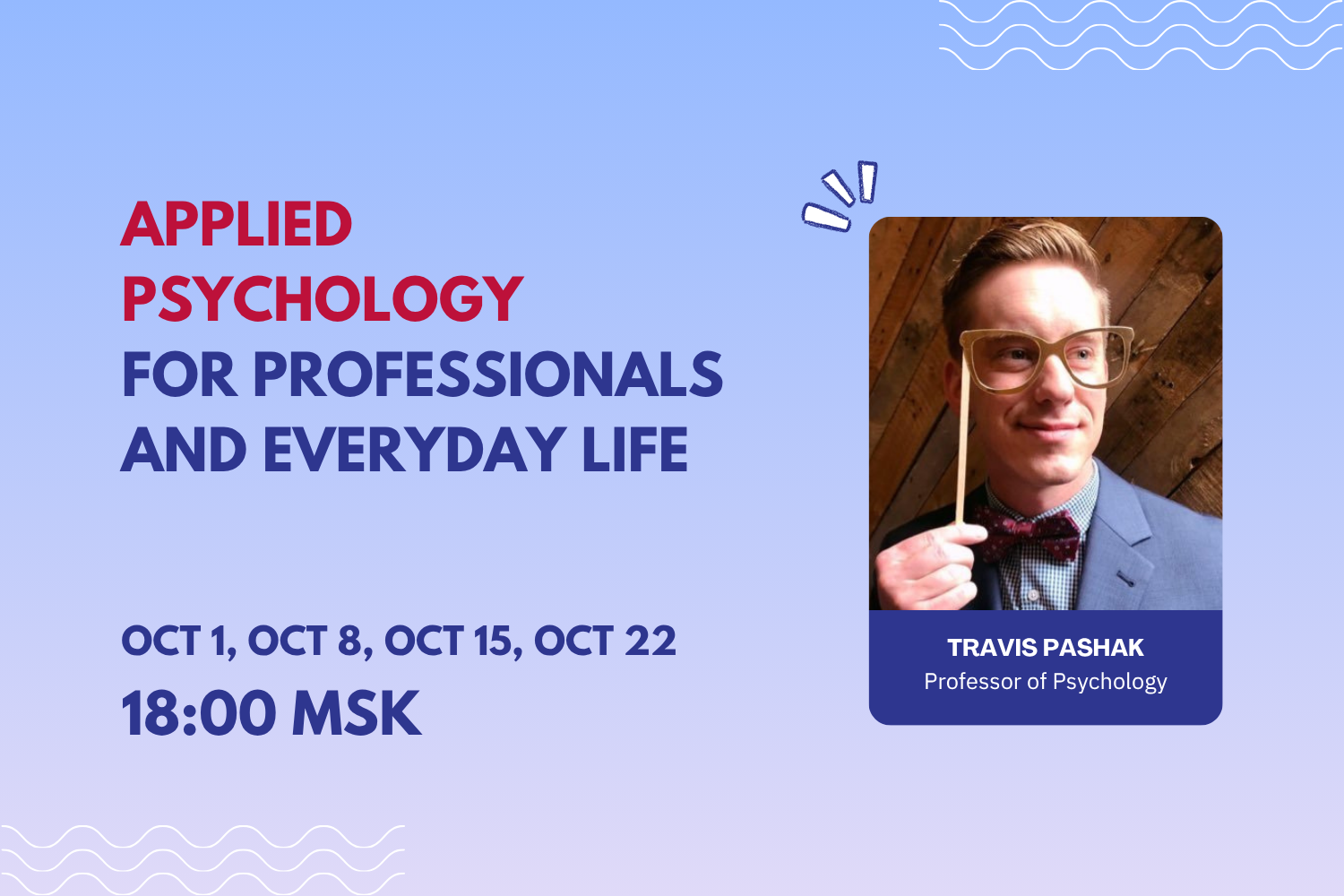
Event Introduction
Dr. Pashak is eager to join Connexions Program this fall in a series of four talks titled "Applied Psychology for Professionals and Everyday Life." In this series, he aims to share some key insights and research findings which are relevant to an array of professionals across diverse disciplines. Discussions will involve crucial interpersonal skills for workplace effectiveness, reflections on inner experience in developing professionals, ways to mitigate common challenges for contemporary workers, and broader analysis of membership in today's communities and societies. The series intends to be thought-provoking and interactive, please join us!
Course Schedule
Session 1. Imposter Syndrome – Oct 1, 18:00 MSK
Session 2. Active Listening Skills – Oct 8, 18:00 MSK
Session 3. Existential Concerns & Mental Health – Oct 15, 18:00 MSK
Session 4. How Are We Affected By Our Communities? – Oct 22, 18:00 MSK
Course Program
Session 1. Imposter Syndrome
Do you ever experience doubt about your professional skills or concerns that you do not deserve your place? Do any of your colleagues report anxiety about inadequacy or uncertainty in their work? If so, this session on "imposter syndrome" may be illuminating for you! We will explore research on imposterism, its prevalence in various settings, ways of measuring the concern, and tactics for alleviating this common stumbling block for new (and seasoned) professionals.
Session 2. Active Listening Skills
Effective listening is a complex and demanding skill to master, yet it is crucial for a great many careers. Important not just for therapists, the ability to engage in active listening will enhance both career and personal life prospects for many people. We will discuss how to practice listening skills, how to apply them in a variety of settings, and how to ensure that your speaker feels heard and empathized.
Session 3. Existential Concerns & Mental Health
Death and dying are topics of concern not only for the elderly and sick. As mortal beings, we all grapple in various ways with the big philosophical questions in our lives (e.g., What do I think of my eventual death? To what degree am I meaningful? How do I navigate the responsibility of making authentic choices?). According to much new research, these and other existential concerns greatly impact both our mental health and our behavior in numerous cultural spaces including work life. This session will explore such topics and work toward comfortable acceptance of our existential limitations.
Session 4. How Are We Affected By Our Communities?
What communities are you part of, and how do they affect you? Some may be immediately obvious, while others may initially be less salient. In many ways, our own personal health and wellness is a direct reflection of our communal functioning. In this session, we will explore the kinds of community spaces people inhabit and the crucial impact they have on our mental health and behavioral effectiveness. We will also give some thought to how we can contribute to our communities and help them thrive!
About the Speaker
Travis J. Pashak, Ph.D., is a Clinical Psychologist and Professor at Saginaw Valley State University in Michigan, USA. He studies mental health and psychotherapy among other topics in psychological science more broadly. He enjoys teaching and mentoring undergraduate students, and also maintains a private practice doing adult counseling. He is currently a fellow in the Ruth and Ted Braun Research Fellowship, running a grant advancing projects in the topic area of existential concerns and psychopathology.