
Event Introduction
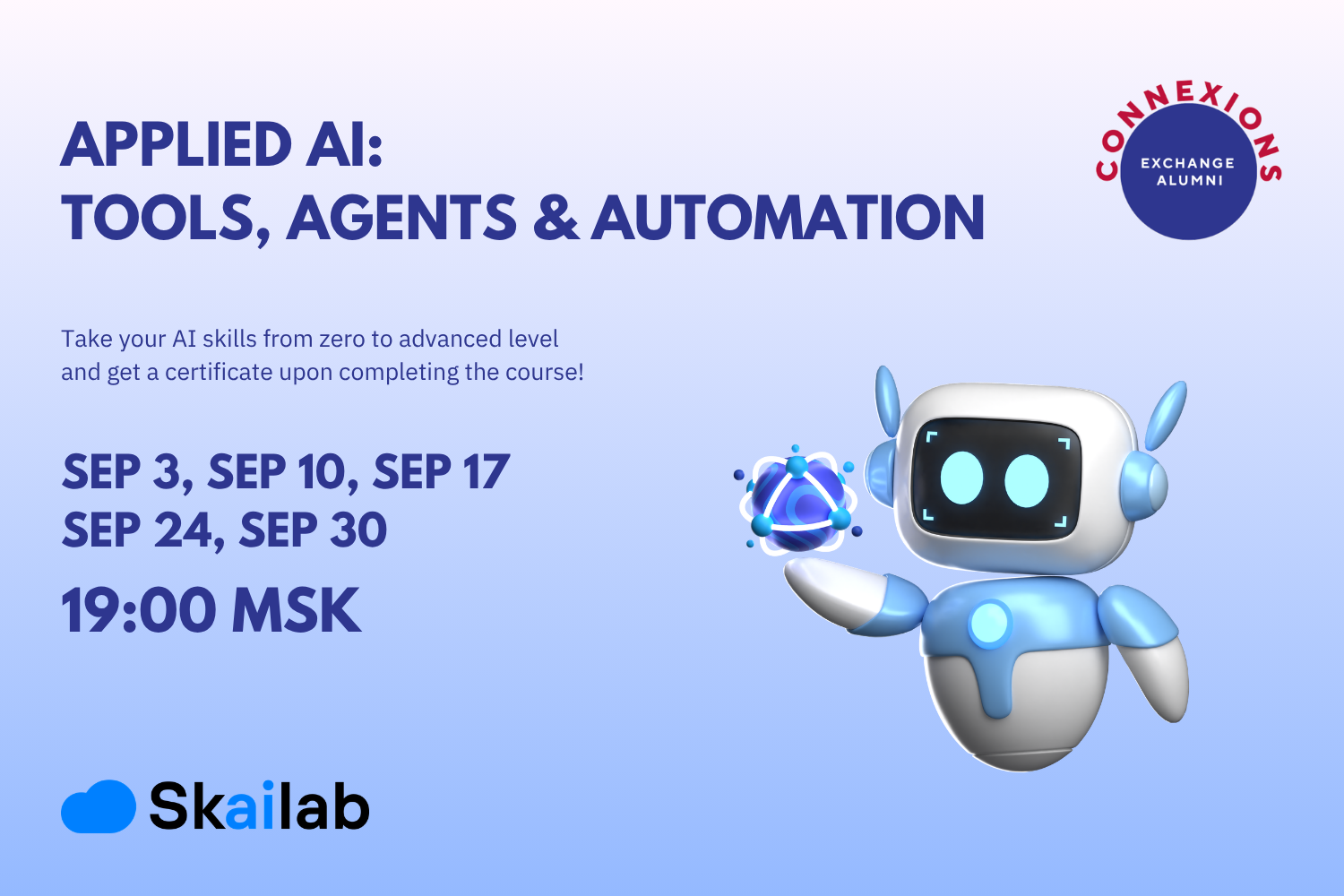
This is a hands-on program on using AI to improve everyday workflows, build AI agents, design automated workflows, and develop an AI adoption strategy. Across five practical workshops, participants move from the fundamentals of working with LLMs to building agents and AI-powered workflows in tools such as ChatGPT, Manus, n8n, and Codex. The program combines core concepts with real-world cases, practical exercises, and a framework for identifying and prioritizing AI automation opportunities.
❗️Important note: This course designed as a complete learning experience.
Unlike most Connexions programs, where you can register for and attend individual sessions, this course will have a fixed group of participants. Applications are open through August 25. After registration closes, the group will be formed, and no new participants will be able to join during the course.
Participants who attend all five sessions will receive a certificate of completion.
Registration closed on August 25.
Who is this course for?
The course is designed for beginners and professionals from any field who want to learn how to use AI in their work. No technical or coding background is required. The program starts with the fundamentals and gradually introduces AI agents, automation, and practical implementation through hands-on examples.
Language: Russian
About the Speakers
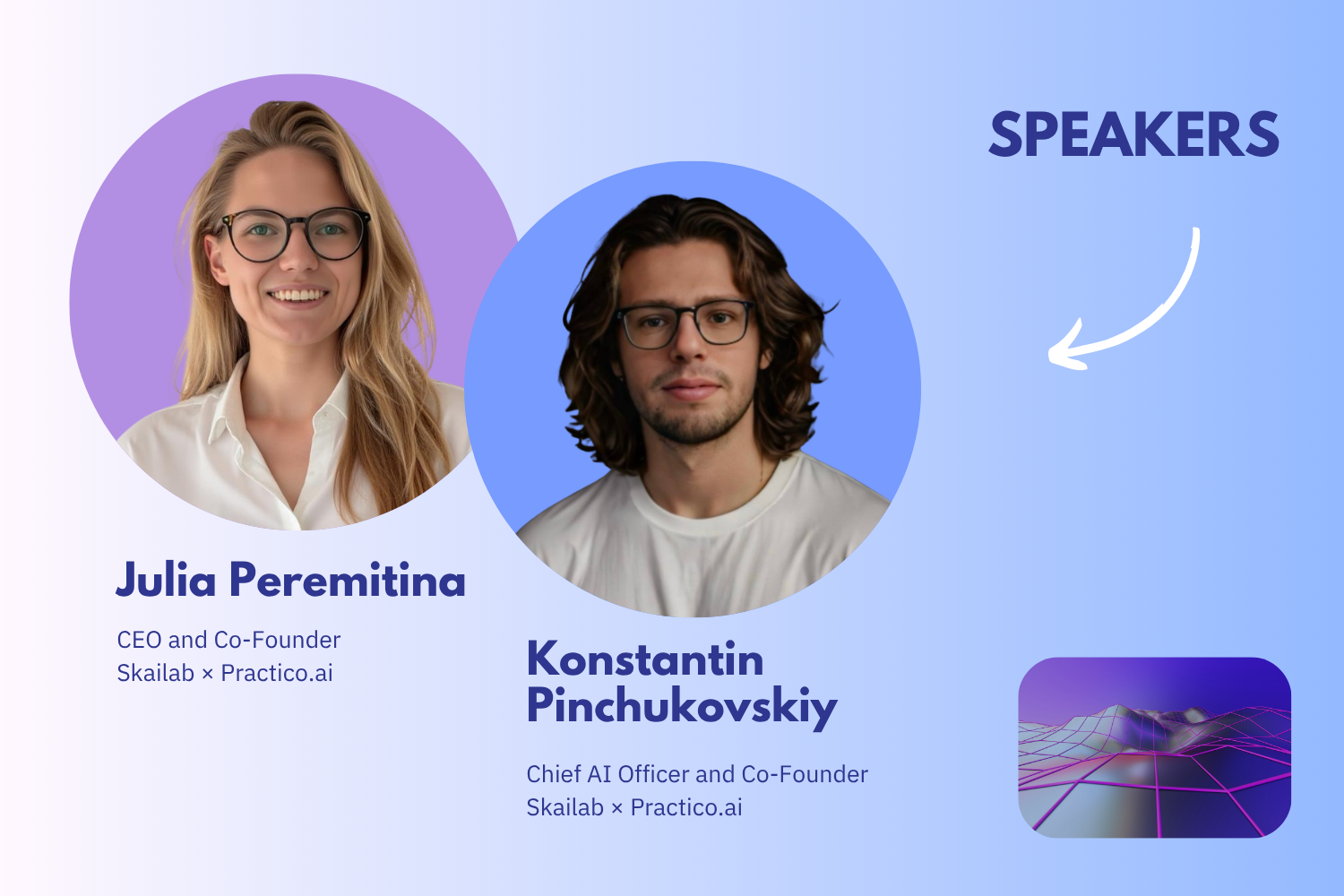
Julia Peremitina
CEO and Co-Founder, Skailab × Practico.ai
Strategy and technology innovation expert with 8+ years of experience across consulting, tech entrepreneurship, corporate innovation, and venture. Background in launching new business units and leading transformation initiatives across international markets.
Expertise: data-driven operational efficiency and change management, growth strategy, business model transformation, and building new innovation-driven business areas.
Konstantin Pinchukovskiy
Chif AI Officer and Co-Founder, Skailab × Practico.ai
AI/ML expert with 6+ years of experience delivering projects across the CIS, MENA, and the US. Background in building and scaling AI capabilities and leading end-to-end AI initiatives — from identifying business needs and pre-sales to solution architecture, implementation, and business impact assessment.
Expertise: AI agents, RAG systems, analytics assistants, and enterprise AI solutions integrated with CRM, ERP, DWH, and BI platforms.
Skailab is an international, full-cycle AI studio operating across three core areas:
AI Consulting & Strategy — audits of business processes, data, and IT infrastructure; identification of bottlenecks and high-impact AI opportunities; development of actionable AI implementation strategies and roadmaps.
Training — corporate training and cohort-based AI education programs.
Development & Implementation — end-to-end design, development, and deployment of AI solutions, from lightweight automation and MVPs to complex enterprise systems and R&D-driven projects.
Course Program
Duration: Each workshop lasts 90–120 minutes.

Workshop 1. AI Fundamentals and Practical Ways of Working with AI
Topics covered:
How the modern AI industry is structured: models, applications, tools, and agentic systems — and how they are connected.
How LLMs work: tokens, context windows, response generation, hallucinations, and other limitations — the minimum knowledge required for informed use.
Task formulation fundamentals: instructions, context, input data, requirements, and output format.
Breaking down multi-step tasks and working iteratively with a model.
Security and data handling: personal data, commercial confidentiality, the limits of using public services, and the importance of verifying results.
Practice:
Working through a case using ChatGPT, NotebookLM and Manus.
ChatGPT: Projects — developing a training program / planning a project; web search and deep research; competitor analysis.
NotebookLM: Creating a project knowledge base using presentations, podcasts, explainer videos, and mind maps.
Manus: Connecting to Telegram and setting up daily news monitoring.
Optional homework: Choose one recurring task, complete it manually in ChatGPT, and document the process steps, input data, and requirements for the desired result.
Workshop 2. Understanding and Setting Up an AI Agent
Topics covered:
What an AI agent is and how it differs from a regular conversation with a model.
How an agent plans a sequence of actions, uses context, and works with external tools.
Core elements of an agent: Skills, Tools, Connectors, and MCP.
The boundaries of agent autonomy and situations where human involvement is required.
Practice:
Working with ChatGPT Work and Manus to create a real AI agent.
Case: Trip Planner — collecting constraints, finding suitable tickets, and creating a travel itinerary.
Setting up persistent rules.
Free skill marketplaces, security checks, configuring skills, and writing your first custom skill for a specific task.
Connecting the necessary tools and data sources.
Optional homework: Build the first version of your own agent for the core tasks identified in Workshop 1, including one external skill and one self-created skill, as well as connectors.
Workshop 3. Visual Solution Architecture in n8n
Topics covered:
Introduction to n8n: interface, node logic, triggers, and integrations.
Patterns for agentic systems: parallelization, decision trees, routing, etc.
Human-in-the-loop (HITL) checkpoints where human participation is required (demo).
How RAG works: chunking, overlap, reranking, Top-k, Top-p, and frequency penalty.
Error handling: retries and fallback scenarios by model or system type, including alerts (demo).
Practice:
Converting the case from Workshop 2 into a visual workflow.
Building the basic logic: trigger → data processing → LLM call → result.
Connecting an external data source.
Case: Responding to customer requests. A customer writes in Telegram; the agent analyzes the intent, determines whether the request is about the product/sales or support, routes it to the appropriate agent, and returns a response.
Routing pattern:
RAG for product information
RAG for support information
Optional homework: Design the architecture of your own agent and build the entire workflow — or its key part — in n8n.
Workshop 4. Building an Agentic Solution in Codex
Topics covered:
Working with Codex: folders, files, and project structure.
Project structure: AGENT.md, agents, skills, hooks, and MCP.
AGENT.md: the system prompt for the entire project.
Agents: sub-agents, how they work, and context delegation.
Skills: general skills and specialized skills for sub-agents; adding external skills and creating custom ones.
Hooks: how hooks work and how to trigger actions in the system.
MCP: what MCP is and how to add external tools (Higgsfield).
Plugins: what plugins are, what they are used for, and how to add them.
Adding an external codebase.
Practice:
Case: Creating content from a raw draft to a video for social media.
Creating the project structure and persistent instructions.
Running the entire process from receiving source materials to producing the final result.
Workshop 5. AI Adoption Strategy
Topics covered:
SKAI framework: the right logic for AI adoption — from business process to architecture.
AI Stack Pyramid: dependencies between layers and why implementation should be designed from the top down.
Three stages of AI maturity.
Identifying tasks for automation: the wrong starting point vs. the right logic — from process to hypothesis.
Where to look for opportunities: five areas — routine tasks, information search and collection, verification and comparison, material preparation, and inconsistent output quality.
How to describe the current process: trigger, owner, input, action, result, and scale.
How to formulate hypotheses: breaking down the hypothesis template using an example — Trigger, Input, Processing, Result, Verification, Metric.
Rule-based logic vs. AI logic: not every task requires AI.
Long list of hypotheses → short list of hypotheses: how to prioritize hypotheses based on impact, frequency and scale, process clarity, data readiness, and prototype readiness.
Prototyping an implementation roadmap: quick wins, medium-term solutions, and long-term solutions.
Practice:
Applying the framework to a real case.